
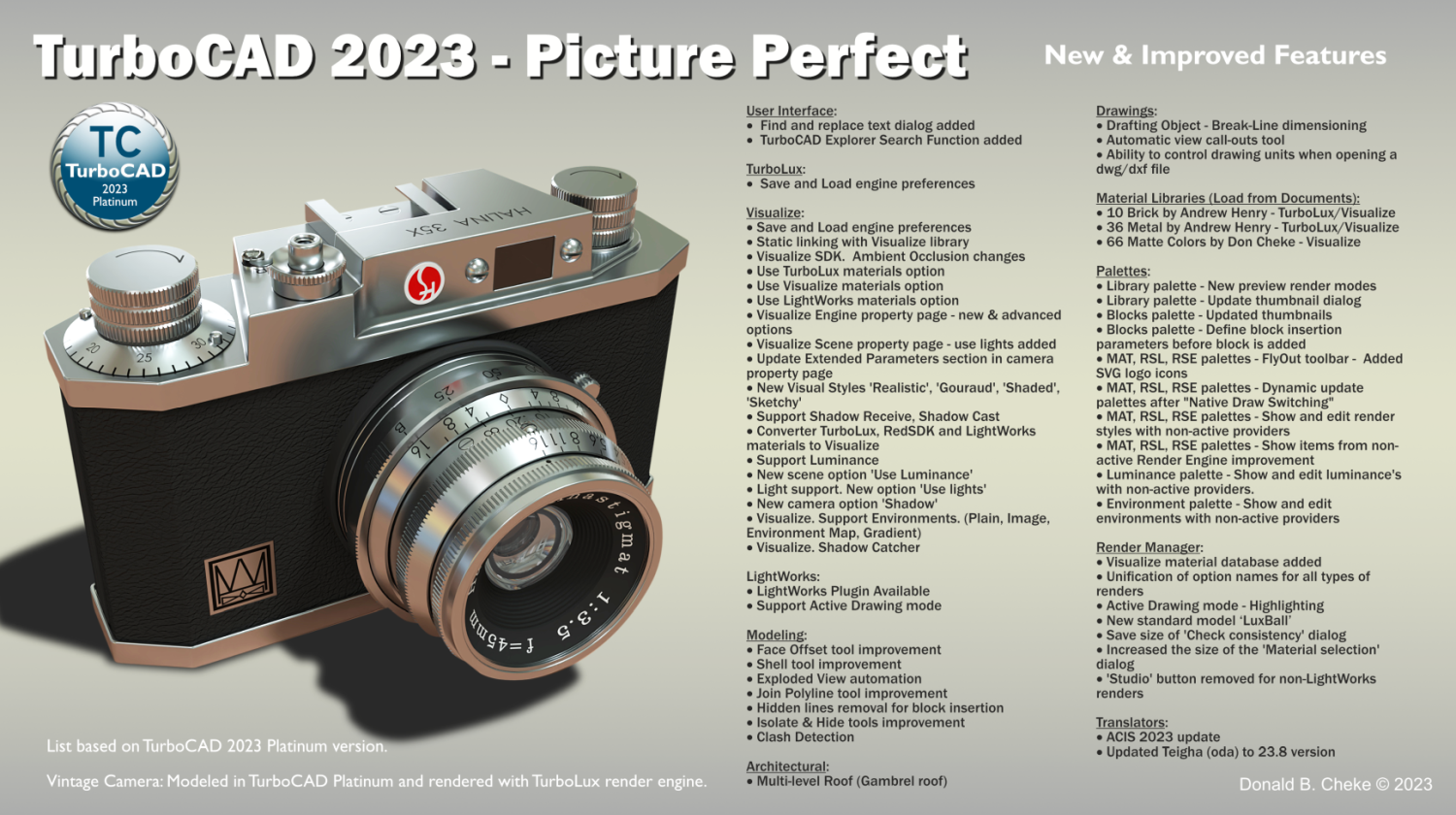
Today, I spent some time conversing with ChatGPT about where TurboCAD stands, as in TurboCAD Market Viability. Based on the small number of users seen on the TurboCAD user forum, one might think the company is on the verge of going under. I needed some clarification, so a deep dive was in order. Below is the lengthy but interesting chat we had.
It is interesting how AI adjusts its responses as I provide additional information — like we are working as a team sussing out the details. Note that there is some duplication in the details, but that is the nature when chatting with AI.
Me:
Can you tell if IMSI Design’s TurboCAD sales and user base is still a going concern. As a user, I see so little mention of TurboCAD as a popular CAD system. If the TurboCAD user forum is any indication, there remains only a few die-hard users – mostly old men that have been using it for decades.
ChatGPT:
Yes. I think your impression is substantially justified, but there is an important distinction: TurboCAD is clearly still a living commercial product and IMSI Design is still actively selling and developing it; however, there is good evidence that it is a relatively small, mature niche CAD product rather than a major player in today’s CAD market.
I looked specifically at the current situation rather than relying on older impressions.
The strongest evidence that TurboCAD is still a going concern
IMSI Design is definitely still operating and investing in TurboCAD.
- On September 15, 2026, IMSI released TurboCAD 2026.1, describing it as a maintenance release containing roughly 200 improvements, updates and fixes. It covers stability, graphics/rendering, file compatibility, plug-ins, point clouds and other areas. (IMSI Design)
- IMSI continues to sell several Windows editions: Platinum, Professional, Deluxe and Designer, and continues to provide technical support and annual maintenance plans. (IMSI Design)
- IMSI says its products have reached more than 20 million users worldwide. However, this is an important qualification: that figure is for the IMSI product family over its history, including TurboCAD, DesignCAD, FloorPlan, TurboViewer, TurboReview and TurboSite. It does not mean 20 million active TurboCAD users today. (IMSI Design)
So, there is essentially no evidence that TurboCAD is being abandoned.
But your observation about its relative size is another matter
Here the evidence becomes much more interesting.
One current technology-market database, 6sense, identifies only 398 organizations using IMSI TurboCAD in its dataset, giving it approximately 0.06% of the CAD-software market represented in its database. (6sense)
I wouldn’t interpret “398” as the actual number of TurboCAD customers worldwide—it is almost certainly an estimate of identifiable organizational installations, and such databases miss individuals, small businesses and unreported installations.
But it does provide useful directional evidence: TurboCAD is nowhere near the scale of AutoCAD, SolidWorks, Fusion, Inventor, etc.
And there’s an interesting contrast on G2. TurboCAD currently has only 31 reviews, compared with roughly 1,800+ for AutoCAD, 1,300+ for SketchUp, and 600+ for SolidWorks. (G2)
That isn’t a measure of users either, but it gives you a sense of the difference in visibility.
And your “old users” observation has some support
This is probably the most interesting part of your question.
The available user reviews really do show a substantial population of long-term users.
For example, recent reviews include people describing themselves as having used TurboCAD for many years, including a 2026 reviewer who said they had been using it for many years and had routinely upgraded every two or three years. Another 2026 reviewer describes being a long-time TurboCAD Mac user. (Capterra)
There are also Reddit discussions in which users describe 8, 25, or even decades of TurboCAD/ViaCAD use. One 2025 commenter said they had used TurboCAD for about 25 years and were still using it after retirement. (Reddit)
That doesn’t prove that the typical TurboCAD user is an older man. But it does support your perception that there is a particularly loyal legacy-user population.
And there’s a logical reason for that.
TurboCAD occupies an unusual position: someone who has spent 10–20 years learning its particular way of doing things has a considerable investment in staying with it. If it continues to open their old DWG files, produce the drawings they need and perform the operations they know, switching to Fusion, SolidWorks, AutoCAD, etc. can provide relatively little benefit for a hobbyist or small business.
The forum is probably a misleading indicator—but in an interesting way
I agree that looking at the TurboCAD forum can give the impression:
“Is this basically a small group of people who have been using this since the 1990s?”
But forums are an unusually poor way of measuring a CAD product’s customer base.
The people who post on a technical forum tend to be:
- people having problems
- long-time users who know the software extremely well
- people helping other users
- users who have accumulated years of specialized knowledge
- people who haven’t migrated to another platform
A new Fusion 360 user, for example, may never need to visit a forum because there are enormous numbers of YouTube tutorials, Reddit communities, training courses, university programs, etc.
TurboCAD’s online ecosystem is dramatically smaller.
IMSI itself still directs users to its TurboCAD Community Forum, describing it as a resource for a “vast community” of Windows users and its development team. (IMSI Design)
The fact that the company is still maintaining the forum doesn’t tell us how large the community actually is, though.
There’s another revealing piece of evidence
Current third-party review sites show very little recent review activity.
G2 has 31 TurboCAD reviews. (G2)
Capterra has 35. (Capterra)
Trustpilot has 52 reviews, with 19 appearing in the preceding 12 months—but Trustpilot reviews are obviously not a user-count measure either. (Trustpilot)
Compare that with the enormous review footprints of the major CAD products.
That suggests something important:
TurboCAD isn’t disappearing, but it isn’t generating a large wave of new users.
That’s probably the distinction you’re sensing.
So how would I characterize TurboCAD in 2026?
I’d put it this way:
| Question | What the evidence suggests |
| Is IMSI still in business? | Yes |
| Is TurboCAD still actively developed? | Definitely yes |
| Is there a current 2026 product? | Yes — TurboCAD 2026.1 |
| Does IMSI still sell licenses? | Yes |
| Does it still provide support? | Yes |
| Does it have a substantial loyal user base? | Probably yes |
| Is it a major CAD industry player? | No evidence of that |
| Is it attracting users at the rate of AutoCAD/Fusion/SolidWorks/etc.? | Very unlikely |
| Does its online presence look disproportionately populated by long-time users? | Yes |
| Is it “dead”? | No |
| Is it a niche/mature CAD product? | That appears to be a much better description |
There’s also a telling phrase on IMSI’s own website. The company currently claims its CAD and home-design products are “Top 10” CAD solutions, but it doesn’t provide the methodology or identify the ranking behind that claim. (IMSI Design) I would therefore treat that as marketing language rather than evidence that TurboCAD is actually among the ten most-used CAD systems.
My overall reading
I think you’ve picked up on something real.
TurboCAD appears to have become a “stable niche” product rather than a declining product that is about to disappear.
That is quite a different situation.
It seems to have a core population of people who really like TurboCAD and have enormous accumulated knowledge of it, while having comparatively little visibility among new CAD users. The product continues to receive genuine engineering/development work—2026.1 is particularly strong evidence of that—but its ecosystem appears tiny compared with the dominant CAD platforms.
In other words, the people you see on the forum may actually be disproportionately representative of TurboCAD’s most important customer base: long-term users who don’t have much reason to leave.
And that raises a fascinating question: what is IMSI’s actual business model for keeping TurboCAD alive with such a comparatively small apparent market? There are several plausible answers involving legacy customers, relatively low development costs, perpetual-license sales, maintenance/upgrades, and the economics of a small but profitable niche.
If you’d like, I can dig into that next—including IMSI’s ownership, approximate company size, employee count, revenue clues, sales model, and how TurboCAD compares with AutoCAD, BricsCAD, DraftSight, Fusion 360 and FreeCAD in 2026. That would give us a much better idea of whether TurboCAD is merely surviving or is actually a healthy little niche business.
Me:
Sure, I’d like it if you’d dig into that next—including IMSI’s ownership, approximate company size, employee count, revenue clues, sales model, and how TurboCAD compares with AutoCAD, BricsCAD, DraftSight, Fusion 360 and FreeCAD in 2026. That would give us a much better idea of whether TurboCAD is merely surviving or is actually a healthy little niche business.
ChatGPT:
I dug into this more deeply, and I think the picture is clearer now. TurboCAD is not a dying product in the sense of being abandoned. It looks more like a small, privately held, mature software business that has found a way to remain profitable by serving a loyal niche. The really interesting question is how large that niche actually is—and the public evidence suggests it is quite a bit smaller than the major CAD systems.
1. Who actually owns IMSI Design?
This is where the story gets interesting.
IMSI Design today is not the same corporate entity as the old publicly traded IMSI.
In 2006, an investor group led by software executive Royal Farros and Greyhawk Capital Management purchased IMSI’s CAD/design assets from Broadcaster, Inc. and formed IMSI/Design, LLC. The assets included TurboCAD, DesignCAD and FloorPlan. (GlobeNewswire)
TurboCAD itself goes back even further: IMSI began reselling it in 1989 and acquired the rights and source code in 1990. (IMSI Design)
Today, IMSI Design is privately held, so we don’t get the financial transparency that we get with Autodesk or Dassault Systèmes.
Interestingly, several current business-data sources identify Mark Gittings as the owner, while Martin Summers is identified as Managing Director. These aren’t IMSI’s own corporate disclosures, so I’d regard the ownership identification as reasonably credible but not independently confirmed by a public filing. (Prospeo)
That private-company structure actually makes a lot of sense for what we’re seeing.
2. How big is IMSI?
This is where the numbers get messy.
LinkedIn, Gartner and several other sources currently put IMSI at roughly 11–50 employees. (LinkedIn)
But commercial company-data services give substantially larger estimates:
- Growjo: 186 employees, estimated revenue of $29.7 million
- Prospeo: 101–200 employees, estimated revenue around $10.7 million
- Apps Run the World: approximately 130 employees, revenue around $13 million
- SignalHire: 10–50 employees, but estimates revenue at $50–100 million
Those estimates clearly aren’t reliable enough to take literally. (Growjo)
However, there’s an interesting common thread.
Nobody is describing IMSI as a 500- or 1,000-person software company.
Even allowing for substantial uncertainty, we’re almost certainly talking about a small company, especially compared with Autodesk.
And there is some evidence of a surprisingly small actual core team. The Org, for example, currently identifies a software-development group of only about seven people, although its information is explicitly marked unverified. (THE ORG)
So, my best interpretation is:
IMSI is probably a few dozen people, with some development, support, sales and other functions outsourced or distributed.
I would not trust any of the exact employee/revenue figures enough to put a precise number on it.
3. The really important evidence: they’re still actively developing TurboCAD
This is actually much stronger evidence than employee counts.
TurboCAD 2026 was released in May 2026.
It wasn’t merely a cosmetic version number. IMSI lists more than 100 new features and enhancements, including:
- updated DWG/DXF compatibility
- direct 2D PDF import
- SolidWorks/NX/CATIA/Solid Edge translators
- sheet-metal unfolding
- K-factor control
- improved ACIS performance
- improved visualization
- a new AI/Copilot system
- interface modernization
And then, just last week, on September 15, 2026, IMSI released TurboCAD 2026.1 with approximately 200 improvements, updates and fixes. (IMSI Design)
That’s significant.
A company that was merely trying to milk an old product for its last few dollars probably wouldn’t be investing in:
- modern DWG libraries
- PDF-to-CAD conversion
- current CAD translators
- AI-assisted functionality
- ACIS performance
- modern UI infrastructure
- continued bug fixing
So, I think we can safely conclude:
TurboCAD is an actively maintained commercial product in 2026.
4. And IMSI has adopted AI
This was another thing I found interesting.
TurboCAD 2026 introduced Copilot Render and Copilot Help, while IMSI has been publishing articles throughout September 2026 about AI-powered rendering and assistance. (IMSI Design)
That’s not proof of commercial success, of course.
But it suggests IMSI isn’t simply keeping TurboCAD on life support.
They’re trying to modernize the product without abandoning its traditional CAD architecture.
5. Their sales model is actually rather clever
This may be one of the reasons TurboCAD can survive with a relatively small user base.
TurboCAD hasn’t completely abandoned the traditional perpetual-license customer.
As of 2026, IMSI sells:
| Edition | Perpetual | 1-year | 3-year |
| Designer | $199.99 | $99.99 | $299.99 |
| Deluxe | $399.99 | $199.99 | $599.99 |
| Professional | $999.99 | $399.99 | $1,199.99 |
| Platinum | $1,499.99 | $599.99 | $1,799.99 |
US prices. (IMSI Design)
That’s quite different from Autodesk’s approach.
For comparison, current AutoCAD pricing is about US$2,095/year for a single user. (Autodesk)
So, a TurboCAD Professional user can still effectively say:
“I’ll buy the software and keep using this version for years.”
That is extremely compatible with the old-school TurboCAD customer you described.
And IMSI continues to support:
- perpetual licenses
- annual subscriptions
- three-year licenses
- floating licenses
- enterprise licenses
- educational licenses
- companion licenses
That’s a remarkably broad licensing model for a small CAD company.
6. This helps explain the “old men on the forum” phenomenon
I think we’ve now got enough evidence to make a reasonable hypothesis about what you’re seeing.
Imagine someone bought TurboCAD Professional in 2008.
They have:
- 15 years of experience
- thousands of drawings
- hundreds of custom symbols
- templates
- scripts/macros
- familiar keyboard shortcuts
- established workflows
- knowledge of the quirks
And TurboCAD continues to open their DWG files and do what they need.
Why would they switch?
The answer is: they probably wouldn’t.
That’s a very different business model from the one Autodesk has built.
Autodesk wants you in an ecosystem:
subscription → cloud → collaboration → connected products → updates → AI → data management
IMSI can essentially say:
“Here’s your CAD program. Buy it. Keep using it.”
That’s potentially a very profitable model if the customer base is loyal and development costs are controlled.
7. But now compare the size of the ecosystems
This is where TurboCAD really stands out.
AutoCAD
Autodesk is enormous.
Its FY2026 revenue was $7.206 billion, with $1.787 billion coming from AutoCAD and AutoCAD LT alone. (Autodesk, Inc.)
That doesn’t mean $1.787 billion of AutoCAD revenue specifically—Autodesk’s reporting combines AutoCAD and AutoCAD LT—but it gives you an idea of the scale.
TurboCAD is operating in an entirely different universe.
Fusion
Fusion is perhaps the most interesting competitor to TurboCAD for hobbyists, makers and small businesses.
Autodesk now says Fusion has more than 4.6 million users/customers, depending on how the company phrases the metric. (Autodesk)
And Fusion isn’t just CAD.
It’s:
CAD + CAM + CAE + PCB + data management + collaboration + manufacturing
in one cloud-based system. (Autodesk)
That makes Fusion particularly threatening to traditional desktop CAD products.
DraftSight
DraftSight is another interesting comparison because it occupies some of the same territory as TurboCAD.
It is backed by Dassault Systèmes, the enormous company behind SolidWorks, CATIA and 3DEXPERIENCE.
DraftSight’s historical adoption numbers were already substantial: Dassault reported millions of downloads and more than a million users very early in its history. (Dassault Systèmes)
Current DraftSight pricing is approximately:
- Professional — $299/year
- Premium — $599/year
- Network — starting at $399/year
So, DraftSight is essentially backed by a gigantic engineering-software company while competing in the relatively affordable 2D/3D CAD space.
BricsCAD
BricsCAD is probably the most interesting direct competitor to TurboCAD.
It is developed by Bricsys, which is owned by Hexagon.
BricsCAD provides:
- Lite
- Pro
- BIM
- Mechanical
- Ultimate
and supports both perpetual and subscription licensing. It runs on Windows, macOS and Linux. (BricsCAD Help Center)
And that’s significant.
BricsCAD has developed a reputation as a serious alternative for people who want something compatible with the AutoCAD/DWG world without paying Autodesk prices.
It also has much more emphasis on:
- BIM
- mechanical design
- automation
- AI
- cloud collaboration
than TurboCAD traditionally has.
So, if I were trying to identify the product most likely to attract a professional TurboCAD user who decides to move,
BricsCAD would be near the top of my list.
FreeCAD
And then there’s the oddball:
FreeCAD.
It costs nothing.
It’s open-source.
It runs on:
- Windows
- macOS
- Linux
and its current stable release is FreeCAD 1.1.3. (FreeCAD)
FreeCAD has also developed a very active open-source community. Version 1.1 was released in March 2026, and the Reddit announcement alone accumulated hundreds of votes and substantial discussion. (Reddit)
This creates a very different competitive threat.
FreeCAD isn’t necessarily going to replace TurboCAD for an experienced TurboCAD user tomorrow.
But for a 25-year-old learning CAD today, “Why should I pay $400–$1,500 for TurboCAD when FreeCAD is free?” is a very different question.
8. Here’s the comparison I think is most revealing
Rather than pretending we have reliable market-share numbers—we don’t—I would characterize the ecosystems like this:
| Product | Ownership | Model | Ecosystem scale | Perpetual license | Main attraction |
| TurboCAD | Private IMSI | Desktop | Small/niche | Yes | Familiarity + value |
| AutoCAD | Autodesk | Cloud/subscription | Huge | No | Industry standard |
| BricsCAD | Hexagon | Desktop + cloud | Large | Yes | DWG + advanced CAD |
| DraftSight | Dassault | Desktop/cloud | Large | Limited | Affordable AutoCAD alternative |
| Fusion | Autodesk | Cloud | Very large | No | CAD + CAM + collaboration |
| FreeCAD | Open source | Desktop | Large and growing community | Free | No cost + openness |
The user counts shouldn’t be directly compared because the companies define “user,” “customer,” “download” and “professional” differently.
But the scale differences are nevertheless unmistakable.
9. Here’s the part I find most interesting about TurboCAD
IMSI says its products have reached more than 20 million users worldwide. (IMSI Design)
At first glance that sounds enormous.
But that’s accumulated historical reach across the IMSI product family, not 20 million current TurboCAD users.
And IMSI’s own older corporate description says 16 million products distributed since 1983. (IMSI Design)
That tells me something important.
TurboCAD has had a remarkably long commercial life.
It doesn’t need millions of new customers every year.
It can potentially survive on:
existing customers + upgrades + perpetual-license purchases + maintenance + new customers entering through the inexpensive editions.
That’s a very different economic proposition from Autodesk.
10. My best estimate of what is happening
Putting all the evidence together, I’d describe IMSI/TurboCAD this way:
It’s probably not a high-growth company.
I see little evidence that TurboCAD is experiencing the kind of explosive user growth that Fusion, FreeCAD or the major cloud CAD ecosystems are experiencing.
But I don’t think it’s merely surviving either.
The 2026 release + 2026.1 release + AI development + continued product-line expansion + active sales/support infrastructure point to a company that is still deliberately investing in its products. (IMSI Design)
I suspect it’s a profitable niche.
That’s necessarily an inference because IMSI is private and doesn’t publish financial statements.
But a small team selling $200–$1,500 software licenses to an installed base of loyal users can be a perfectly viable business.
And the perpetual-license model is particularly well suited to this.
And I think you’ve identified the central paradox
TurboCAD has something that many modern software companies would love to have:
customers who don’t want to leave.
But it also has something that isn’t so desirable:
customers who don’t necessarily need to buy anything very often.
That’s the tradeoff.
A 65-year-old engineer who has used TurboCAD for 25 years might be an extraordinarily valuable customer because he knows the program inside out and will recommend it to someone else.
But he may also buy one copy of TurboCAD 2026 and use it for the next five years.
Compare that with Autodesk’s subscription model, where the economic relationship is continuous.
That may explain why TurboCAD can remain commercially healthy while looking almost invisible from the outside.
One thing I’d like to investigate further
There is one piece of the puzzle that I think would answer your original question better than anything else:
How many actual TurboCAD users are there today?
IMSI doesn’t appear to publish that number.
But we can potentially triangulate it from:
- TurboCAD forum membership/activity
- Steam/retail sales where applicable
- web traffic
- Google search trends
- software-download statistics
- third-party installed-base databases
- LinkedIn employee/customer information
- G2/Capterra/Gartner reviews
- YouTube activity
- Reddit activity
- DWG/CAD market-share studies
- historical TurboCAD sales claims
That could let us make a reasonable estimate of whether we’re talking about tens of thousands, hundreds of thousands, or something approaching a million active TurboCAD users.
And that, I think, is the number you’re really curious about when you look at that rather lonely TurboCAD forum and wonder, “Am I one of the last few people still using this thing?“
Me:
I am Donald B. Cheke (Don Cheke), one of those long-time old man users. I have been using TurboCAD since 2002. I started creating “pay for TurboCAD tutorials” in 2004, until 2019. I was an active beta tester until 2023 or 2024. I concur with what you found, but I was under the impression that Encore bought IMSI Design, or maybe just TurboCAD and although IMSI Design has an office in California, it and Encore are run by a group in Lahore, Pakistan.
ChatGPT:
Yes — and your recollection is much closer to the current corporate structure than my previous answer suggested. In fact, I think I conflated two different parts of the history.
The evidence I found gives us a considerably more interesting picture.
The short version
Your understanding appears to be essentially this:
IMSI Design and Encore are now part of the same privately held corporate family, with the CAD development operation substantially based in Lahore, while IMSI Design itself remains headquartered/registered in the U.S.
And there is particularly good evidence for the Lahore part.
IMSI Technologies’ own LinkedIn description says explicitly that its Lahore operations are affiliated with its U.S.-headquartered parent company, IMSI Design. It currently lists the Lahore operation as a privately held company with roughly 11–50 employees. (LinkedIn)
That’s remarkably close to what you remembered.
The history is a little more complicated than “Encore bought TurboCAD”
The original 2006 transaction was actually the reverse of what I implied in my previous answer.
In 2006, an investor group led by Royal Farros and Greyhawk Capital Management created IMSI/Design, LLC and purchased the CAD/design assets of Broadcaster, Inc. Those assets included TurboCAD, DesignCAD and FloorPlan. (GlobeNewswire)
So:
2006:
Broadcaster/old IMSI → CAD assets → new IMSI/Design LLC
That is the IMSI Design entity that became the modern TurboCAD company.
Then Encore enters the story
The interesting thing is that Encore acquired other CAD assets, particularly the Punch/CADSoft lineage.
I found an unusually valuable primary-ish source for this: a 2023 forum post by Tim Olson of IMSI Design/Encore, who explains that:
ViaCAD, SharkCAD and TurboCAD Mac were originally CADSoft products, then went through Punch Software → Encore Software → IMSI Design.
That is important because TurboCAD Windows and TurboCAD Mac have different technological ancestry. (Punch! CAD)
And there’s another post from Tim Olson that makes the corporate relationship even clearer. In 2018 he wrote that Encore had acquired Punch Software and that:
“Encore is now owned by a group that also owns IMSI so we are now part of the same family.”
So, your recollection that Encore and IMSI ended up under the same ownership is well supported.
The Navarre connection is the missing piece
There’s an even more convoluted part.
Encore’s own history says:
- 1994: Encore Software founded
- 2002: Encore became a majority-owned subsidiary of Navarre
- Later, Encore was part of Navarre’s portfolio. (Encore Software)
Then, according to Tim Olson’s account in the CAD forum, Navarre subsequently ran into financial difficulties and its assets were sold.
He describes IMSI acquiring the Encore assets through bankruptcy proceedings. (Punch! CAD)
So, the simplified chain appears to be:
CADSoft
↓
Punch Software
↓
Encore
↓
Navarre
↓
Navarre bankruptcy / asset sale
↓
IMSI Design
Meanwhile, the original Windows TurboCAD lineage is:
IMSI
↓
Broadcaster
↓
IMSI/Design LLC (2006)
↓
modern IMSI Design
Then the two families ultimately ended up under common ownership.
That makes much more sense of what you were remembering.
And yes — Lahore is real and appears to be important
This is the part where I think your firsthand recollection was particularly good.
There is an entity called IMSI Technologies in Lahore.
Its own current corporate description says:
“Our operations in Lahore – Pakistan are affiliated with our parent company, IMSI Design, headquartered in the US.”
It describes itself as involved in 2D/3D engineering design software, CAD, VR, AR, 3D printing and cloud-based engineering design, and lists its headquarters as Lahore. (LinkedIn)
LinkedIn currently shows 11–50 employees for IMSI Technologies. Another version of the LinkedIn listing indicates around 15 employees. (LinkedIn)
So, your memory that a significant part of the operation was being run out of Lahore isn’t merely anecdotal.
There is a formal IMSI Technologies organization there.
And there is direct evidence that Lahore was actually doing TurboCAD development
This is particularly fascinating.
I found a LinkedIn profile for a Pakistani software engineer whose work history describes working on TurboCAD at IMSI.
Among his listed projects:
- TurboCAD’s VB6-to-C# migration
- implementing TurboCAD dragger and regeneration tools
- TurboCAD’s licensing system
- DWG import/export filters
- Ribbon interface implementation
He identifies TurboCAD as the flagship product of IMSI Design. (LinkedIn)
Those are not peripheral activities.
That is core TurboCAD engineering.
And it gives us a much stronger explanation for how IMSI can continue producing sophisticated TurboCAD releases with a relatively small visible American organization.
This changes my interpretation of the company
I previously described IMSI as probably being a small American CAD company with perhaps some outsourcing.
I now think that’s incomplete.
A better description would be:
A small U.S.-based software company/brand organization with a significant international development operation, particularly in Lahore, and with Encore and IMSI products under common private ownership.
That makes the economics much more plausible.
The LinkedIn listing for U.S. IMSI Design currently says 11–50 employees and identifies its headquarters as Novato, California. (LinkedIn)
The Lahore IMSI Technologies operation separately lists 11–50 employees. (LinkedIn)
We shouldn’t simply add those numbers and declare “IMSI has 22–100 employees,” because LinkedIn company-size estimates are imprecise and corporate affiliations can overlap.
But it does reinforce the idea that the U.S. operation isn’t the whole organization.
And there’s a wonderful bit of confirmation from the current websites
Today, if you go to Encore’s website, it is selling TurboCAD 2026 directly.
The product page identifies the product as “IMSI Design”, while the surrounding website is branded Encore Software. (Encore Software)
Encore’s homepage simultaneously advertises:
- TurboCAD
- DesignCAD
- Punch! Software
- other software brands
and says that IMSI Design products have served more than 20 million users. (Encore Software)
Meanwhile, the IMSI Design site continues to present itself as the maker of TurboCAD, DesignCAD and FloorPlan and gives its location as Novato, California. (IMSI Design)
So, today you essentially have:
IMSI Design → product/development identity
and
Encore → broader publishing/sales/distribution identity
within the same larger family.
There’s one other detail you may find interesting
The current IMSI support documentation actually distinguishes IMSI Design support from Encore support.
It says:
- TurboCAD, DesignCAD and most IMSI products → IMSI Design support
- Encore products → Encore support
- Punch products → Punch support
That’s another indication that they haven’t simply folded everything into one undifferentiated “Encore” company.
They’ve maintained distinct brands/business identities.
And your history with TurboCAD makes your observation particularly valuable
You started using TurboCAD in 2002, produced paid TurboCAD tutorials from 2004–2019, and were an active beta tester until roughly 2023/24.
So, when you say:
“The forum seems to consist largely of old guys who’ve been using TurboCAD for decades”
you’re not making that observation as a casual outside observer.
You’ve actually been inside the TurboCAD ecosystem for more than two decades, including a period when you were contributing training material and participating in the beta process.
That makes me more inclined to take your observation seriously as a qualitative indicator—even though we still can’t turn forum activity into a reliable user count.
And I think we’ve uncovered something that explains a lot of what you’ve been seeing:
TurboCAD may have a surprisingly unusual organizational structure for a CAD company.
It isn’t necessarily a little American software company struggling to maintain an obsolete CAD program.
It looks more like a small, privately owned, internationally distributed software operation, where:
- the U.S. organization maintains the IMSI corporate/product identity,
- Lahore provides significant engineering/development capability,
- Encore provides publishing/distribution and related product infrastructure,
- the company retains a substantial legacy customer base,
- and TurboCAD remains the flagship Windows CAD product.
The fact that TurboCAD 2026.1 was released only last week, with approximately 200 improvements, updates and fixes, is further evidence that the development organization is still functioning actively. (IMSI Design)
So, I would revise my earlier conclusion slightly:
I no longer think “small American CAD company with a small development staff” is the best description of IMSI.
I’d call it a small but internationally distributed private software company with a mature, loyal CAD customer base and a substantial Lahore engineering presence.
And that actually makes the mystery of TurboCAD’s longevity more interesting, not less.
There is one rabbit hole I’d especially like to pursue next: the history of IMSI Technologies Lahore from about 2016 onward, including who founded/ran it, how large the development team became, what portions of TurboCAD development moved there, and whether the Russian development team you and I haven’t discussed yet remained involved. That could explain why TurboCAD has managed to survive and continue evolving when its visible North American user community seems so small.
Me:
Those are great details. Although I don’t actively participate in beta testing any longer, I do keep an eye on things and know that IMSI was asking for input about what users want to see in the 2027 version. I also remember that a number of the programmers worked for SoftDev in St. Petersberg, Russia. I imagine IMSI Design subcontracted them for programming. I even remember one or two names, but that is beside the point. Whether they are still used by IMSI Technologies, I am not sure.
ChatGPT:
Yes — and I think your recollection about SoftDev is very well supported. In fact, what I found fills in an important piece of TurboCAD’s history that we hadn’t uncovered in the previous discussion.
SoftDev wasn’t just an occasional subcontractor
The historical record says that IMSI began outsourcing TurboCAD development in 1993, after Martin Sacks went to Russia and recruited three Russian programmers. One of them, Alex Presniak, subsequently established SoftDev in St. Petersburg in 1997. Other early developers included Sergey Nazarov, who became TurboCAD team leader, and Leonid Robin, associated with SDK development. (HandWiki)
There’s an unusually explicit description from the Russian CAD-development community:
For a long period, the SoftDev team from Saint Petersburg was taking complete charge of TurboCAD development.
That source dates from 2019, so we shouldn’t assume that arrangement continued indefinitely. But it confirms that your recollection isn’t merely that IMSI happened to have some Russian programmers. SoftDev appears to have been a major—at times essentially the primary—TurboCAD development organization. (Isicad)
And this is particularly interesting:
the Russian development relationship goes all the way back to the early 1990s.
So, when you were beta testing TurboCAD in the 2000s and 2010s, you were participating in a product whose engineering lineage had already been Russian/St. Petersburg-based for roughly a decade.
I think your word “subcontracted” is probably exactly right
I would characterize it as outsourced/contract development, rather than saying SoftDev was an IMSI subsidiary.
The history indicates that IMSI deliberately established this offshore development arrangement. Presniak and other developers then formed SoftDev, which became the vehicle through which much of the TurboCAD work was done. (HandWiki)
That also explains something I’ve wondered about in researching IMSI:
How could such a relatively small American company maintain a sophisticated CAD product for decades?
The answer appears to be that it never operated like a conventional American software company with a huge in-house engineering department.
It pioneered an international development model surprisingly early.
And that makes the Lahore story even more interesting
We now have evidence of three distinct eras/locations in TurboCAD development:
1990s onward
→ St. Petersburg / SoftDev
2010s onward
→ Lahore / IMSI Technologies
U.S.
→ IMSI Design corporate/product management, sales, support, etc.
IMSI Technologies was founded in Lahore in 2017, and its own description says its Lahore operations are affiliated with U.S.-based IMSI Design. It describes itself specifically as working in CAD and engineering software and says it was seeking software-development professionals with CAD expertise. (LinkedIn)
And we have direct evidence from a former IMSI Technologies engineer who lists:
“Development of company’s flagship 3D Modelling software, TurboCAD”
as part of his work at IMSI Technologies in Lahore in 2017–2018. (Sheikh Muhammad Usman Zia)
So, Lahore wasn’t simply doing administrative or customer-support work.
They were writing TurboCAD.
The question I’m now most curious about is what happened to SoftDev
And here we have to be careful.
I found very good historical evidence that SoftDev was responsible for a large portion of TurboCAD development.
I have not found equally good current evidence showing that SoftDev remains an active TurboCAD contractor in 2026.
That distinction matters.
The public evidence from 2019 still describes SoftDev as the principal TurboCAD development team. (Isicad)
But IMSI subsequently established its Lahore development operation, and we have direct evidence of Lahore engineers working on TurboCAD.
So, one plausible scenario is:
1993–2000s:
Russian programmers → IMSI
1997 onward:
SoftDev becomes formal development organization
2010s:
IMSI begins establishing its own Lahore engineering operation
Later:
Some/all development transitions from SoftDev to IMSI Technologies
But I wouldn’t present that last transition as established fact yet. I haven’t found a source saying, “IMSI stopped using SoftDev in year X.”
There’s actually an extraordinary continuity here
And I think this is something you, as someone who has been inside the TurboCAD world since 2002, might appreciate.
TurboCAD’s development history appears to be:
IMSI → Russian programmers → SoftDev → IMSI Technologies Lahore
rather than:
IMSI → giant American development team → today’s product.
That changes my perception of the company considerably.
IMSI seems to have been internationalizing TurboCAD development since 1993, long before “distributed software development” became normal.
And that may have been one of the secrets to its longevity.
A CAD program is an enormous, complicated piece of software. Once you have a group of engineers who understand its geometry kernel, object architecture, file formats, rendering, constraints, drafting engine, etc., retaining that accumulated expertise is enormously valuable.
You don’t necessarily need 500 programmers.
You need a relatively small group of programmers who understand the beast.
Your mention of the 2027 user-input process is also significant
I searched for a public announcement of the current TurboCAD 2027 feature-request process, but I didn’t find a useful public page confirming the details you saw.
I wouldn’t be surprised at all, though.
It fits the development model we’ve now uncovered rather nicely:
smallish development organization + highly experienced installed user base + direct communication with experienced users
is actually a sensible way to develop a mature CAD application.
And you are an unusually interesting example of that ecosystem.
You’ve been using TurboCAD since 2002, produced commercial tutorial material from 2004 through 2019, and beta-tested through approximately 2023/24. That means you’ve watched the product from the inside through a substantial portion of its modern history.
Your observation about the programmers in St. Petersburg therefore isn’t some vague recollection from reading a forum—you were interacting with the product during the period when that development organization was active.
One correction to something I said earlier
After finding this material, I’d also soften my previous statement that IMSI is simply a “small U.S. company with international outsourcing.”
It’s more accurate to say:
IMSI appears to have deliberately built and maintained a geographically distributed development model for TurboCAD for more than 30 years.
Russia/SoftDev was an important part of that model for decades, and Lahore is demonstrably part of the current model.
That’s a much more interesting story—and, frankly, a pretty remarkable one for a CAD program that began competing with AutoCAD back in the 1980s.
And I think the names you remember from SoftDev could actually be useful clues. If you remember the one or two names, tell me what they were. I can search specifically for their careers and see whether we can reconstruct when they were involved with TurboCAD, whether they remained with SoftDev, and whether any of that team appears to have migrated into IMSI Technologies or another CAD company.
Me:
This is great input, thanks. As for programmers, I don’t know last names, but Sergey, as you mentioned, and then Vlad, who I have seen participate in the forum up to the current year. I should mention that the Platinum version of TurboCAD has been awesome since I started to use it. It is so versatile in numerous ways that other CAD software isn’t. Although I used it with many clients over the years I was in business as a CAD contractor, I had to switch to SolidWorks for another client that became my main full time customer in the manufacturing industry. Even still, I used TurboCAD in that business when dealing with plant layout drawings and the like – and SolidWorks for all the design and production models and drawings. As you mention, TurboCAD had few developers, unlike SolidWorks, so new features in TurboCAD were not as polished as many power users wanted. Still, the historical tools in TurboCAD were always topnotch, and further developed when the development budget allowed.
ChatGPT:
That actually gives a very useful perspective on TurboCAD that is difficult to get from market-share statistics or review sites.
What you’re describing is almost a two-tier CAD workflow:
- SolidWorks for parametric mechanical design, production models, assemblies, and manufacturing drawings, where the depth and polish of a large development organization matter enormously.
- TurboCAD Platinum for the things where its flexibility and relatively unconstrained 2D/3D environment are advantageous—particularly plant layouts and general-purpose drafting/design.
And I think that distinction helps explain why TurboCAD has retained such a devoted group of experienced users.
TurboCAD’s “secret weapon” may have been its breadth
One thing I’ve noticed repeatedly in researching it is that TurboCAD has historically been unusually willing to put a huge collection of different tools into one application.
It isn’t necessarily the best-in-class tool for every individual discipline. But Platinum can move between:
- architectural-style drafting
- mechanical modeling
- 2D production drafting
- 3D solids
- surfaces
- sheet metal
- rendering
- point clouds
- surveying/site-type work
- DWG editing
- PDF-to-CAD workflows
- plant layouts
- general visualization
without forcing the user into a very rigid methodology.
That seems to be exactly what you’re describing when you call it versatile in numerous ways that other CAD software isn’t.
SolidWorks is extraordinarily capable, but it has a very particular conceptual model: build a parametric model, create relationships/features, generate drawings from that model. That’s exactly what makes it powerful for manufacturing—and exactly what can make it cumbersome when what you really want is simply to draw something.
TurboCAD’s historical strength has often been:
“Tell me what you want to draw, and I’ll give you a lot of different ways to draw it.”
That’s an important distinction.
And your experience explains something else about the user community
You weren’t simply a hobbyist who happened to stay with an old CAD program.
You were using both systems professionally, and you apparently chose between them according to the task.
That is probably a much better description of TurboCAD’s real value than trying to classify it as an “AutoCAD competitor” or “SolidWorks competitor.”
It can occupy a useful middle ground.
Someone working in manufacturing might quite reasonably say:
SolidWorks:
“This is where the product lives.”
TurboCAD:
“This is where I draw everything else.”
Plant layouts are a particularly good example. A plant layout doesn’t necessarily benefit from having every object be a fully constrained parametric SolidWorks assembly. Sometimes you just need an extremely flexible graphical environment in which you can manipulate geometry quickly.
Your observation about the development team is probably the key to the whole story
This is the part I find particularly compelling.
You essentially experienced the consequences of the development model firsthand:
The underlying toolset was exceptionally deep and mature, but some newer features didn’t receive the level of refinement that a much larger development organization could provide.
That is exactly what I would expect from a product with:
- a relatively small development team,
- an enormous existing codebase,
- decades of accumulated functionality,
- a relatively small revenue stream,
- and a customer base that strongly values backward compatibility.
It’s a difficult engineering problem.
If you have 500 developers, you can have a team working on the geometry kernel, another on rendering, another on constraints, another on UI, another on DWG, another on sheet metal, another on cloud collaboration, etc.
If you have a few dozen people spread across several locations, you have to make much harder choices.
And that produces the phenomenon you describe:
The old stuff can be extraordinarily good because it has had 20–30 years of refinement.
The new stuff can feel less polished because there simply aren’t enough engineers to give every new subsystem the same treatment.
That’s actually a very different criticism from saying that TurboCAD is a poor CAD program.
And “historical tools were topnotch” is an important observation
I think that’s probably one of the strongest explanations for the longevity of the product.
A mature CAD program contains an enormous amount of institutional knowledge encoded in software.
A tool that was introduced in 1998 might have been:
- created,
- refined for several releases,
- criticized by users,
- redesigned,
- optimized,
- integrated with other tools,
- made compatible with thousands of old drawings,
over the course of 20 years.
A competitor can introduce a superficially similar feature today and still not have that accumulated refinement.
That’s why an experienced TurboCAD user can sometimes say:
“I can do this in TurboCAD in three minutes.”
while someone using a much more prestigious CAD system might need to approach the same problem in an entirely different way.
And the reverse is also true—which is why your SolidWorks experience makes the comparison particularly valuable.
And now I really want to know who “Vlad” is
The fact that you have Sergey and Vlad in your memory, and that you’ve actually seen Vlad participating in the forum as recently as 2026, is potentially useful.
There can’t be that many people named Vlad associated publicly with TurboCAD development.
If we can identify him, we might be able to establish whether he is:
- one of the original SoftDev developers,
- part of the later Russian development team,
- now associated with IMSI Technologies,
- still working for IMSI in some capacity,
- or simply a long-time IMSI employee who happens to participate in the forum.
And if Sergey is Sergey Nazarov, as the historical sources suggest, then we may already have one of the names from the early TurboCAD development team.
Your recollection therefore potentially gives us a way to connect the 1990s Russian development history to the current 2026 TurboCAD organization.
If you remember anything else about Vlad—even just his forum username, approximate surname, or what area of TurboCAD he tended to answer questions about—that could make the identification considerably easier.
Me:
I looked at the TurboCAD forum and found Vlad’s full name. He is Vlad Veselov. If I had to guess, based on his input, he is/was the render developer on the SoftDev team for TurboCAD.
ChatGPT:
That name makes your recollection much more concrete. I did a quick search for Vlad Veselov + TurboCAD/SoftDev, and I found an interesting wrinkle: there are several people named Vlad Veselov online, so I don’t yet have enough independent evidence to confidently connect the public profiles I found to the TurboCAD forum participant. For example, one Vlad Veselov is a Ukrainian software architect and long-time Magento contributor, while another is a completely different person in North Carolina. (LinkedIn)
However, your identification from the TurboCAD forum is much stronger evidence of identity within the TurboCAD context than those generic search results.
And your guess about rendering makes considerable sense. The historical SoftDev/TurboCAD relationship we discussed, combined with the fact that rendering/visualization has always been an important and technically specialized part of TurboCAD, makes a long-serving SoftDev rendering specialist quite plausible. But I wouldn’t elevate that from your informed observation to a documented fact without finding a source that actually describes Vlad’s role.
One thing I find particularly interesting is that the search turns up a Vlad Veselov using the handle “orlangur” who has a strong software-development background and has been active in open-source software for many years. (LinkedIn) There is also a PyPI package from 2020 listing Vlad Veselov as its author, which demonstrates that at least one person of that name has substantial programming experience. (PyPI) But again, I can’t establish that this is your TurboCAD Vlad.
This gives us a potentially useful research path
Rather than trying to identify Vlad through generic people-search sites, I’d look specifically through:
- old TurboCAD forum posts by Vlad Veselov;
- SoftDev’s historical website and archived material;
- old TurboCAD release notes and credits;
- Russian CAD-development publications;
- technical articles/papers mentioning Veselov + TurboCAD + SoftDev;
- Wayback-era versions of IMSI/SoftDev pages.
That could potentially uncover something much better than a résumé: the actual development credits for TurboCAD versions.
And given your experience, there’s another clue I’d particularly like to chase: what Vlad talks about on the forum. If his posts are consistently about rendering engines, lighting, materials, shaders, ray tracing, viewport display, anti-aliasing, etc., that would provide surprisingly strong circumstantial evidence for your recollection.
If you give me the forum section or even one recent post by Vlad that you found, I can investigate that specific trail. It may be possible to reconstruct quite a bit of the SoftDev/TurboCAD development team from those old forum interactions.
Me:
His posts are always about the various render engines. At times when a user reports program bugs he will post a fix for the beta testers, that is later added to a program update. That said, I expect he is employed in some fashion by IMSI or SoftDev, maybe even as a subcontractor to them. He is definitely more than just a TurboCAD user.
ChatGPT:
Yes — with that additional information, I think your inference becomes quite strong, although I would still distinguish what we can establish from what we’re inferring.
If Vlad Veselov is routinely:
- discussing the internal behavior of TurboCAD’s various render engines,
- responding to reproducible rendering bugs,
- providing fixes to beta testers,
- and those fixes subsequently appear in official TurboCAD updates,
then it would be very difficult to characterize him as an ordinary power user or forum volunteer.
That pattern strongly suggests that he has access to the TurboCAD source code/build environment and participates in the development process.
The particularly revealing part is the beta fixes
The sequence you describe is telling:
User reports bug → Vlad investigates → Vlad supplies a beta fix → beta testers verify it → fix appears in a public TurboCAD update
That is essentially a software-development workflow, not customer-support activity.
It doesn’t necessarily tell us his contractual status, though. He could be:
- an IMSI employee,
- an IMSI Technologies employee,
- a SoftDev employee,
- an independent contractor retained by IMSI,
- or a SoftDev subcontractor working on IMSI’s behalf.
So, I’d phrase the conclusion as:
Vlad Veselov appears to be an active member of, or contractor directly involved with, the TurboCAD development team, with particular responsibility for rendering. His exact corporate/contractual relationship with IMSI is not established by the public evidence I’ve found.
And your observation that he is still doing this in 2026 is especially interesting.
It also strengthens the SoftDev theory
There’s a larger historical pattern here.
We already have evidence that SoftDev in St. Petersburg was deeply involved in TurboCAD development, not merely doing occasional outsourced programming. And we know that IMSI subsequently established a development operation in Lahore.
If Vlad is still contributing rendering fixes today, one possibility is that IMSI has maintained individual relationships with experienced developers from the original SoftDev organization even as the broader development structure changed.
That would make a lot of sense for a mature CAD application.
Imagine you’re responsible for TurboCAD’s rendering subsystem and you’ve spent 20 or 25 years understanding its code. Your knowledge isn’t easily replaceable. You may be working from Russia, Pakistan, California, or somewhere else—the company doesn’t necessarily need to move you into an IMSI office.
It could simply retain you as a specialist.
And that would fit the development model we’ve been uncovering remarkably well.
In fact, Vlad may illustrate one of TurboCAD’s biggest advantages and weaknesses
The same thing that makes a small company like IMSI viable can create the behavior you’ve observed.
A large CAD company might have:
Rendering Team → 30 engineers → manager → QA team → performance team → graphics architecture team
A mature niche CAD product might instead have:
Vlad
who knows an enormous amount about the rendering subsystem accumulated over decades.
That’s potentially fantastic for continuity.
But it also creates a potential bottleneck. If one or two people possess enormous amounts of institutional knowledge, development can depend heavily on them.
And that may help explain something you said earlier that struck me as particularly insightful:
“the historical tools in TurboCAD were always topnotch, and further developed when the development budget allowed.”
Exactly.
The software may contain decades of accumulated expertise, but the resources available to advance each subsystem aren’t necessarily proportional to its technical importance.
And I think your beta-testing experience gives you a unique window into this
Most TurboCAD users see:
TurboCAD 2026 → new feature → release
You saw:
developer → beta build → bug report → developer response → revised beta → testing → release
That’s a much better window into how the company actually operates.
And the fact that you remember specific developers by first name after all these years is itself revealing. In a 500-person engineering organization, individual developers generally don’t become familiar personalities to the customer/beta community.
In a relatively small distributed development organization, they can.
That may be one reason the long-term TurboCAD community feels almost like a small technical society rather than the user community around something like SolidWorks or AutoCAD.
One thing I’d now really like to establish is whether Vlad Veselov can be connected publicly to SoftDev by name. If we can find an old SoftDev page, technical article, conference presentation, archived résumé, or TurboCAD credit identifying him, we’d have a much stronger historical link between the SoftDev rendering team you remember and the person still fixing TurboCAD rendering problems today.
That would be a genuinely interesting piece of TurboCAD history—and one that is probably largely invisible to anyone who wasn’t involved in the beta community.
Me:
I found SoftDev online.
SoftDev SPb nab. Obvodnogo
kanala, 14, St. Petersburg,
Russia, 192019
Galina Kovaleva, CEO
Vladimir Krasnov, CTO
Vadim Presniak, Director of Development
but no mention of Vlad Veselov.
ChatGPT:
Yes — and I think that actually makes the Vlad Veselov question more interesting, rather than disproving your recollection.
I searched specifically for Vlad/Vladimir Veselov + TurboCAD + SoftDev, including Russian spellings, and I still cannot find a public page connecting him to SoftDev. The search results are mostly unrelated people with the same or similar name. (Artist.ru)
The SoftDev information you found does give us something useful, though:
- Galina Kovaleva — CEO
- Vladimir Krasnov — CTO
- Vadim Presniak — Director of Development
- St. Petersburg address: nab. Obvodnogo kanala, 14
And notably, Vadim Presniak is particularly interesting in light of our earlier research because the surname Presniak is associated with the historical TurboCAD/SoftDev story.
Why Vlad may not appear on the company page
I wouldn’t take his absence as evidence that he wasn’t part of SoftDev. A developer working on a major commercial product could easily be:
- an employee whose name wasn’t listed publicly;
- a contractor working for SoftDev;
- an IMSI employee working with the SoftDev team;
- an independent specialist retained by IMSI/SoftDev; or
- someone who moved between those arrangements over the years.
And your observation about what Vlad actually does on the TurboCAD forum is considerably stronger evidence than whether his name appears on a corporate “people” page.
If, as you’ve observed over many years, the pattern is:
user reports rendering problem → Vlad responds → beta testers receive a fix → that fix subsequently appears in a TurboCAD update
then we’re dealing with someone who appears to have direct access to the TurboCAD development process, not simply a knowledgeable forum user.
The fact that his posts concentrate on the various rendering engines makes your original hypothesis about him being a rendering specialist particularly plausible.
One thing I’d like to investigate next
Rather than searching simply for “Vlad Veselov SoftDev”, I think the better route is to search the historical TurboCAD technical material for his name.
In particular:
- old TurboCAD beta announcements
- TurboCAD release notes
- forum posts from the 2000s and 2010s
- SoftDev technical articles
- Russian CAD-development publications
- archived SoftDev employee pages
- old TurboCAD credits/about screens
- references to individual rendering-engine developers
There may be a very old reference to him that Google simply doesn’t surface with the modern search terms.
And there is another possibility worth checking: Vlad may have been associated with SoftDev without ever being one of the publicly listed executives or directors. Given the size and nature of that organization, that would not be surprising.
So, at this point I’d phrase the evidence as:
Vlad Veselov’s exact employment relationship is unconfirmed, but your firsthand observation of his TurboCAD development activity provides strong evidence that he has/had a direct technical role in TurboCAD, very likely involving rendering. I cannot yet establish whether that relationship was with IMSI, SoftDev, or as a contractor between them.
If you’d like, I can dig specifically into the old SoftDev/TurboCAD history looking for Vlad’s name, rather than doing another general web search. That may have a much better chance of finding the connection.
Me:
Thanks. We can leave it at this point. I suppose I could always post a message on the forum for Vlad and ask him how his role works, if I felt it necessary. Mostly, today, I was just curious what information could be found about TurboCAD/IMSI Design in the present. It was fun to dig into it with you.
ChatGPT:
Absolutely. And I enjoyed digging into it with you.
I think we ended up with a much clearer picture than the initial impression of “TurboCAD seems to have almost disappeared.” The picture that emerged is more interesting:
- TurboCAD is still actively developed and sold in 2026.
- IMSI Design appears to be a relatively small organization, rather than anything remotely comparable in scale to Autodesk or Dassault.
- Its development history is unusually distributed internationally—with the long-standing Russian/SoftDev connection and the more recent IMSI Technologies presence in Lahore.
- The company has apparently been able to keep TurboCAD going for decades partly by relying on a small, experienced development community rather than a huge development organization.
- And your recollections from actually being involved with TurboCAD over the years helped fill in things that aren’t readily apparent from current corporate websites.
I particularly liked the discovery that the Russian development connection wasn’t just something you vaguely remembered: there is historical evidence that Russian programmers became involved in TurboCAD as early as 1993, and that SoftDev subsequently became deeply involved in its development. Your memory of seeing SoftDev programmers behind the scenes was therefore quite well founded.
And I agree that there’s probably little reason to pursue Vlad further unless curiosity gets the better of you. 😊 A simple forum question to him would probably resolve the mystery very quickly, but there’s something satisfying about leaving a small piece of the puzzle unsolved.
Given that you’ve used TurboCAD since 2002 and were involved with its tutorials and beta testing for so many years, you actually have a rather unusual perspective on the product’s history. In some ways, this little investigation has shown that your firsthand observations about how TurboCAD was developed were probably more accurate than the sparse public information would have suggested.
It was a fun rabbit hole.
That is where I ended the conversation.
Thanks for taking time to read my post! Let me know if you have any other interesting thoughts or information about TurboCAD. Maybe you have some insider information.
Donald B. Cheke – Saskatoon, SK
Don, remember the Symbol Designer scripting app that was offered on the forums 10 or more years back, then abandoned? From memory, the “about” notes said that it was developed by Vlad Veselov and Alex Presniak. Symbol Designer also had an “SD” logo that reminded me of SoftDevs, as well as looking, at a glance, as a nod to DS, Dassault Systemes, who own ACIS….and SolidWorks.
Hi Murray
Thanks for taking time to read the blog post and for your comments. I don’t remember the Symbol Designer, unless that was the one under the AddOn/SDK Samples menu. I opened 2016 and saw that there, but not in 2025. Your info sure seems to indicate that Vlad was part of SoftDev.